

This page is also available in Arabic.
What it does
Every time someone here accepts or rejects a proposed match on the payment settlements page, that verdict is kept. This page is what the engine made of them: a curve that turns a score into a measured probability, a set of weights fitted to this workspace's own decisions, and the policy that says when a proposal may be accepted without anyone.
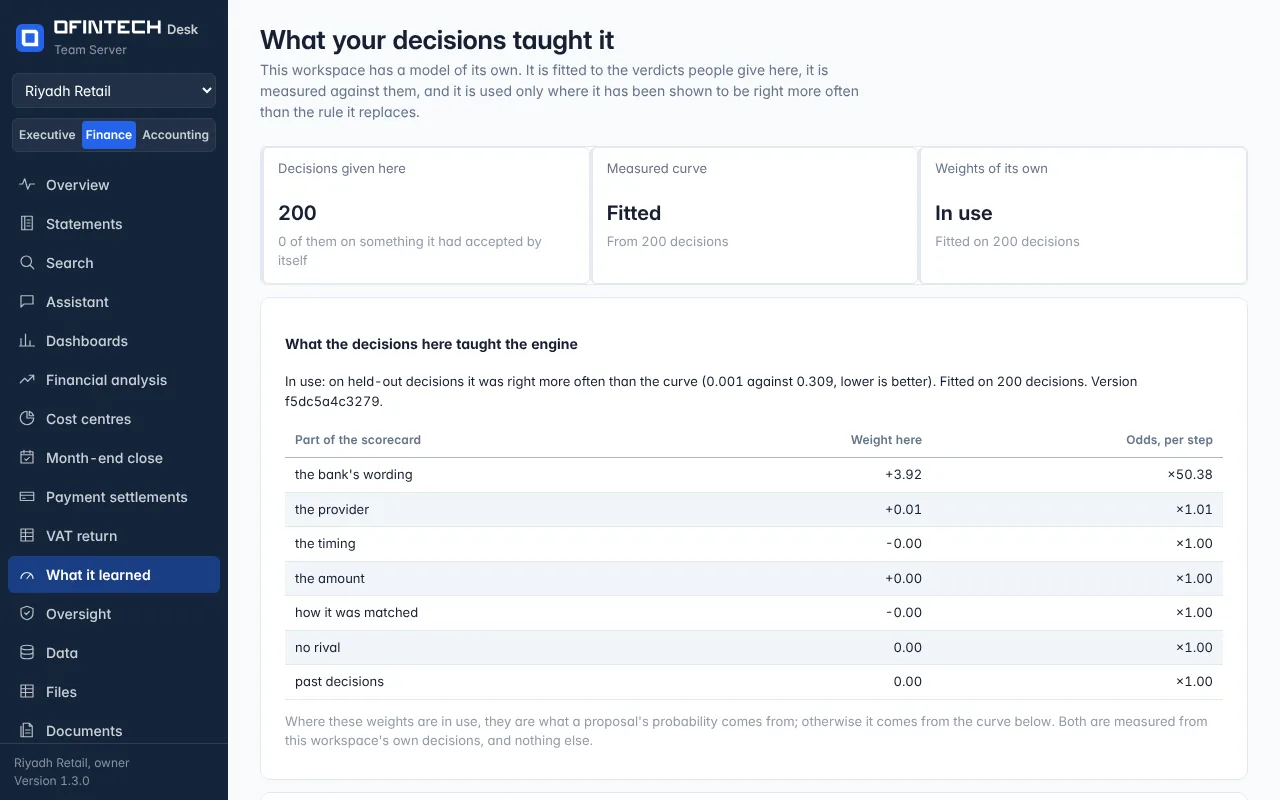
Three figures stand at the top. Decisions given here counts the verdicts, and says how many of them were on proposals the desk had already accepted by itself. Measured curve says whether there are enough of them — 30 — to turn a score into a probability by measurement rather than by assumption. Weights of its own says whether a model fitted here is deciding anything today; it needs 120 decisions before it is even fitted, and it is used only where it beat the curve on decisions it had never seen.
Why it is there
A scorecard says 870 out of 1000. On its own that number means nothing: it is the engine's opinion of itself. What makes it mean something is this workspace's own history — of the proposals that scored like this one, how many did a person accept? That is a measurement, and it can only be made where the decisions were made.
All of this was already running. It sat at the foot of the payment settlements page, under the reconciliation, where someone who wanted to know whether the desk had learned anything had to go looking. It is a page now because that is what it is: a model that belongs to this workspace, fitted to the verdicts given in it, and used only where it has earned the right.
When to open it
- Before raising the threshold, to see what the engine's confidence has actually been worth here
- After a month of reconciliation, to see what the decisions taught it
- When a proposal was accepted without anyone and you want to know on what basis
- When an administrator wants the corrected lines, to fit a better reader of bank wording
How it works
How sure, measured is the curve. The table groups the proposals by what they scored, and beside each band it shows how many decisions fell in it, what the curve says the probability is, and what people actually said. The two columns should be close; where they are not, the curve moves to the people.
What the decisions here taught the engine is a seven-part model — how it was matched, the amount, the timing, the provider, the bank's wording, whether there was a rival, and past decisions — with one readable weight each and the odds it multiplies by. It is fitted on part of the decisions and measured on the rest, and the page prints both scores (lower is better). If it did not win, it says so and the scorecard's own weights stand.
Accepting without a person is the policy: the threshold a measured probability must clear (97% by default), and how often an acceptance made without anyone is put in front of a person anyway to confirm (one in 20 by default). That second number is not a formality — it is the only way the top of the curve is ever measured, because proposals nobody sees produce no verdicts. An administrator changes these, is asked for their password again, and the change is written to the audit log.
The lines people here have put right are the corrections themselves. They are this workspace's own bank wording, so they do not leave: an administrator downloads the file and a better reader is fitted on your own machine.
Nothing on this page is a general model of anything, and nothing is sent anywhere to produce it. The curve is this workspace's decisions relabelling its own scores; the weights are fitted here and kept here.
A scenario
A month in, the page reads: 142 decisions, curve fitted, weights of its own In use — 0.081 against the curve's 0.094 on decisions it had never seen. The curve's table shows that proposals scoring 90–100% were accepted by people 99% of the time, and those scoring 70–80% only 76% of the time. The administrator leaves the threshold at 97, and the week's split payments keep waiting for a person — which is the right answer, and now it is a measured one.
Steps
Decide as usual
Every verdict on a proposed match in Payment settlements is what this page is made of.
Watch the three figures
A curve needs 30 decisions; weights of its own need 120 and have to beat the curve.
Set the policy
An administrator sets the threshold and how often an automatic acceptance is confirmed by a person.
Take the corrected lines
An administrator downloads them and fits a better reader on your own machine; the wording never leaves.
Questions
Does anything leave the workspace?
No. The curve and the weights are fitted inside the engine from this workspace's own verdicts, and the file of corrected lines is downloaded by an administrator and fitted on your own machine.
Why is the page empty?
It learns from decisions on proposed matches, so it starts when payment settlements does — on a plan that includes it, once somebody has decided on a proposed match.
It says the weights are not good enough yet.
They are measured against the curve on decisions they were not fitted on. Until they win that comparison the scorecard's own weights stand, and the page prints both scores.
Does any of this change my books?
No. It only decides whether a proposed match waits for a person. Nothing is posted anywhere by this page.